Friday, June 10, 2011

It's a Prickly Life

When we drove a local gravel road the other day the visuals quickly changed from small town shops and restaurants to scrub desert, hills, ravines, endless views if you're up high . . . typical in rural Arizona.  

Wildlife was plentiful.  Hawks and golden eagles looked for mice and squirrels, and lotsa snakes that didn't like human companionship went about their business,  pushing these same mice and squirrels back into their burrows.

Flowers provided a carnival of color...prickly poppies, penstemons already tall, prickly pear in bloom.   

Prickly Poppies grow anywhere there's disturbed soil . . . roadsides, old garages, abandoned houses.  The attractive blossom belies the rest of  the plant. . . stems, leaves, and seed pods are covered with spines.
True to the poppy family the seeds provide a slight narcotic effect, if you're willing to endure working with the spine covered seed pod ( above,left....below, right/left).
Despite the wind that curled the petals a small butterfly negotiated its way to the flower, looking for nectar in all the meager places. 
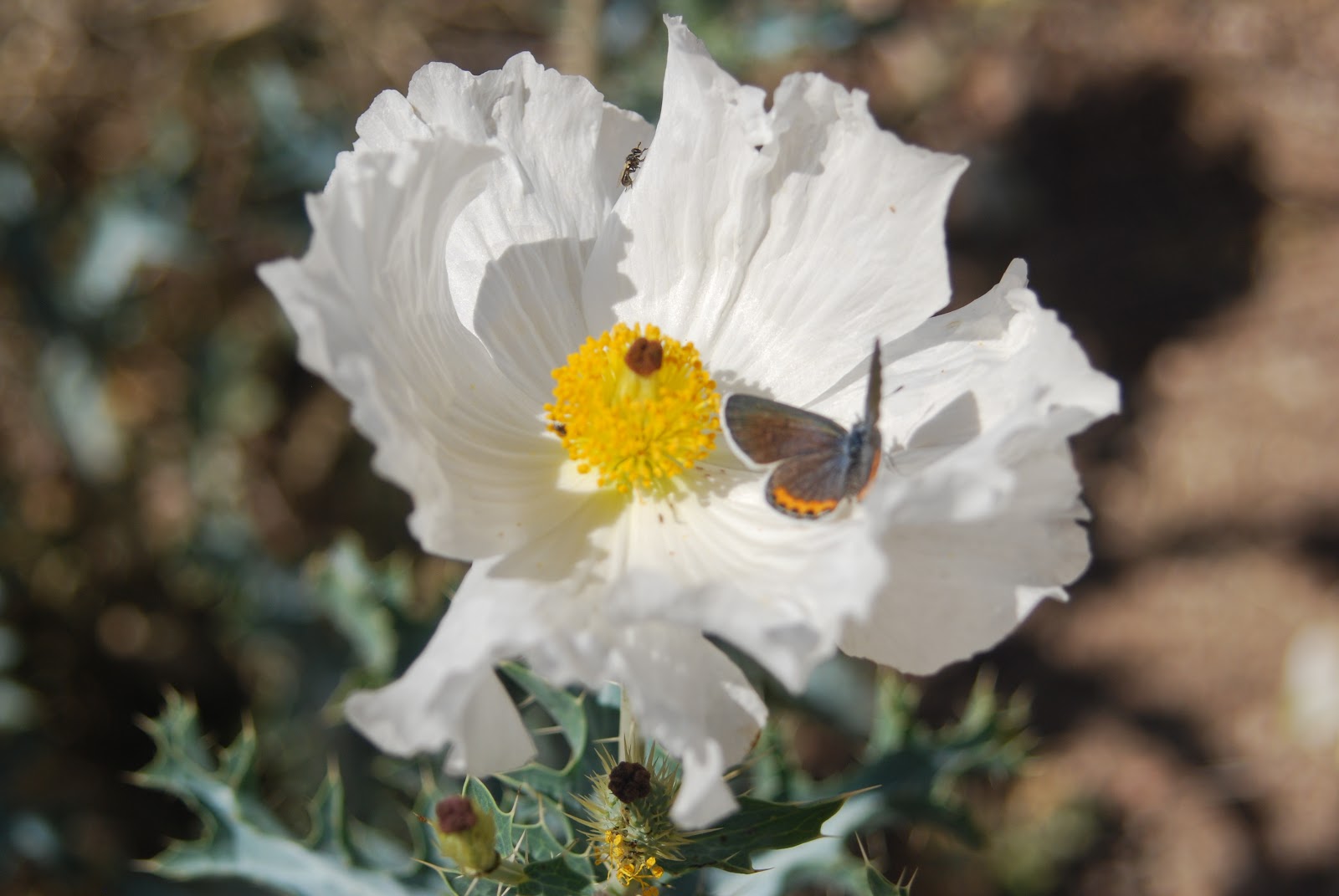
 It doesn't take much to sustain a butterfly, but it was a lucky photo opportunity.  

Nectar attracts these pollinators but the attraction is momentary until they travel to the next flower . . .maybe another prickly poppy.
But...maybe not.
  
Next for the butterfly was another plant with spines.  Unlike the prickly poppy, the prickly pear has a stem that has morphed into a spongy, water storing pad and "leaves" that have evolved to water conserving spines.  The pads carry a waxy coating that prevents water loss.  Shallow roots absorb the minimal desert rainfall, exaggerated reproductive characteristics (flowers) attract pollinators.  
The drive for life takes many forms.

Labels: , , , , , , , , , , ,

Monday, June 6, 2011

Nectar Is Sweet Stuff

We took a mini-trip over a local, seldom traveled gravel road in rural Az just for the helluvit. The road takes you into whatever still exists of undeveloped acres in rural Arizona. . . hills, scrub grassland, grease wood, brittle bush, and solitude. Just a dusty road and endless views.  
It's the type of environment that suggests you should change your auto air filter at the next opportunity.

These bees ain't Odysseus responding to the Sirens call and facing destruction.   In fact, there doesn't seem to be a risk to their activity.  They want nectar.
Bees of all kinds were having a play-day among the anthers and filaments of the flowers.


Going head-down for nectar, a bee actively stirs the anthers.  It's premature...the flower hasn't matured sufficiently for pollen to have been produced.  Usually you can see the grains spread around the petals.  But, the nectar is there and the bee wants it. 


Mellifera ligustica has a long proboscis (tongue) which extends to draw up nectar and water.

Belly down in stuff , a bee takes the hard way to its goal.

We often don't see the "little ones" that make life possible.  Our life is crowded with irrelevances.


After a long day of activity the cycle will begin again.  Probably tomorrow...flowers fertilized...bees happy...life continued...our auto air filter not replaced.  Life is perpetuated by small things.
  
However, the irony may escape our view.  Some bastard will use a fly swatter and an innocent perpetuator of life will bite the same dust that clogs my auto air filter.  

Labels: , , , , , , , , , , ,

Friday, May 13, 2011

Flowers of Boyce Thompson Arboretum

Honey Bee arrives for. . . dinner?  It doesn't realize but will certainly enter as a 2nd or 3rd party into an orgy of cactus fertilization.  Usually there are several that take part.
Open petals are sexy for bees and insects.  Bees have an easy time...among humans sex is selective, between flowers and bees, sex is indiscriminate.  .
Showered by fallen Paloverde blossoms this Hedgehog Cactus stands out.  It says, "Hey, look at me!!"  The Paloverde blossoms have had their chance.
Either a beaver tail cactus or what Boyce Thompson Arboretum calls a "red prickly pear cactus flower" it stands out like a stop light in the desert traffic.
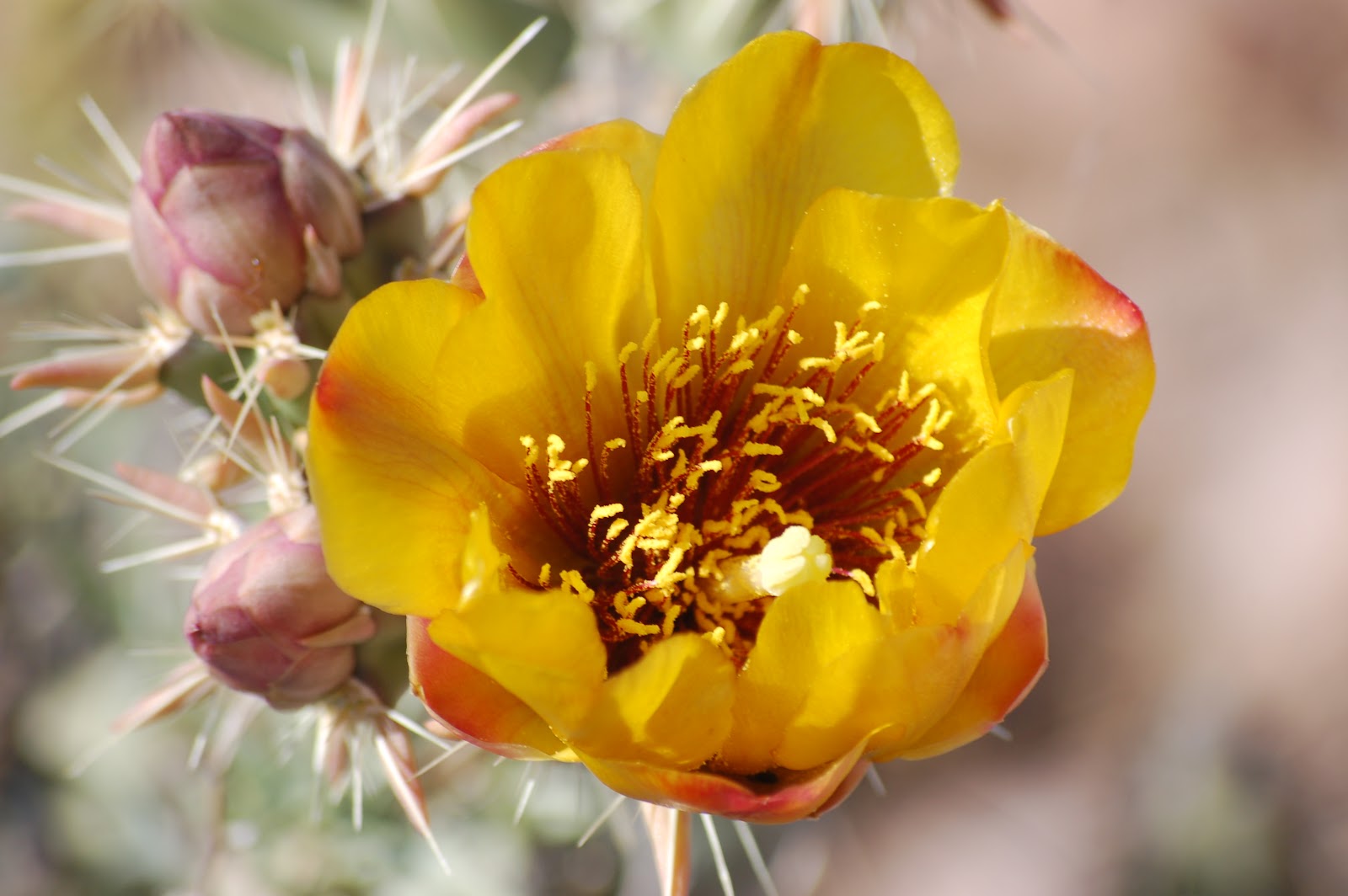
One of the common yellow blossoms of the prickly pear.
The yellow/red is a common variation within the prickly pear family.  The prickly pear is notoriously "promiscuous", allowing pollen from a variety of related and unrelated species.
One of the Boyce Thompson "variants" from its "Cactus Garden."


Labels: , , , , , , ,

Tuesday, May 10, 2011

Invisibly Green

We must have hit it at just the right time.  
The Jeep bounced along a dirt road into the Superstition Wilderness which, these days, is merely a playground for Phoenix area residents. . . with wilderness rules. 
We were looking for cactus flowers but never guessed we'd come across green ones.  I've wandered this part of the desert for years but have never had the opportunity to see the Teddy Bear Cholla in bloom.
Maybe I just wasn't looking . . .or had unconsciously restricted my visual thinking to the more common yellows, orange, magenta, or other colors that decorate these plants.  But...green?  I knew they were out there, but just never "saw" them.  
Cylindropuntia bigelovii is a cactus native to California, Arizona, New Mexico  and northwestern Mexico.  Enlarged stems carry out photosynthesis and store water.  Unlike other succulents, the stem is the only part where this process takes place.
Flowers of some cacti form long tubes (up to 30 cm) so only certain species of moths can pollinate the blossoms. There are also specializations of this cholla for specific species of bats, hummingbirds and bees. To confuse us, the duration of flowering is highly variable...and probably the reason I've missed the event in past years.   
 
Summer was a month away but the intensity of the southern Arizona sun got to us after several days.  Your instinct is to cover up with a broad-brimmed hat, long sleeves and long pants.  We did exactly that but beat a quick retreat to a local motel when it became uncomfortable.
Seed formation of these cacti is prolific and the fruits are conspicuous.  A menagerie of goats, moths, birds, ants, mice and bats eat the fruit contributing to seed dispersal and cactus reproduction.


Some cacti have a waxy coating on their stems to prevent water loss. Because of the plants' water-retention ability, detached sections of the plant can survive for long periods and grow new roots when rain comes.
These Teddy Bears are resourceful, leaving no aspect of their reproduction to chance.
Bees, spiders and other bugs take care of pollination.  Moths, birds, mice and bats eat the fruit and disperse seeds.  Their last method of "reproduction" is more insidious...stem sections detach when brushed by passing humans, dogs, foxes, javelina or other desert inhabitants. 

Perhaps the next time you pass too closely and say, "OUCH!" and use a comb or tweezer to remove a stem section, smile and remember you're part of a group effort to help cylindropuntia bigelovii give birth.

Labels: , , , , , ,

Thursday, May 5, 2011

Wondering and Wandering in the Superstitions

If you're going to the Superstition Wilderness Area and not planning to camp, the only place to bed down at night is the nearby town of Apache Junction.  Thirty years ago this town was simply a crossroad of Arizona Rt. 88 and a road whose name I've forgotten.  Today, the town has a population of 37,000 and is a bedroom community of Phoenix.


Weaver's Needle is a landmark in the Superstition Wilderness.  Named
 for Pauline Weaver, a cavalry officer, it gained notoriety as being integral
to the supposed location of the Lost Dutchman's Gold.
  

The Apache Junction Motel was delightful because of its low rates and the nearby Mickey D's Cafe was delightful because of its oatmeal.  Low rates at the motel were balanced by outrageous prices at the gas pump.
The unique Teddy Bear Cholla blossoms belie the unique message the
spines convey: stay away unless you want a nightmare involving boots,
pants, socks, and even minutes later, car seats. 
Mickey D's Cafe had a sign proclaiming, "Because of the Current Drought, Water Will be Served Only on Request."   The nearby cacti would think that a good idea.


A bright Buckhorn Cholla can range in color  from red to orange to a
 brownish yellow...the spines have a serious purpose, also, but not quite
 as insidious.   
Our friend, the Western Diamondback, was never seen again.  I was happy it didn't want to be friends and I'm sure it was happy not to be in the company of Jeeps.


As most cacti and critters in the desert, a Western Diamondback rattlesnake
has "spines" of it's own.  It disagreed with our presence and struck at
the tire of our Jeep.  Except for  a missing fang or two all was OK.  The
fangs are replaced quickly. 
Despite the fangs and spines that are ubiquitous in the desert...it does have great sunsets.


All's well that ends well!


Labels: , , , , , ,

Wednesday, June 30, 2010

Lavender, White, and Red


Globemallows are common along the roadsides of Arizona...ranging in color from white to lavender, orange through red.  In the Spring and probably throughout most of the year these plants have sex. 
To get the full story you'll have to look to the bees and other crawlers whose primary purpose is to gather pollen.  It's only a secondary purpose to fertilize these flowers.
While the flowers leave reproduction to an industrious bee or thirsty hummingbird, it's none-the-less disconcerting that something as important as reproduction is abandoned to a secondary instinct.
 
We can contemplate this thought but get few productive results...
...or just look at the pics and realize that maybe flowers know something we don't.
This blog is dedicated to Olivia Judson whose column for the New York Times has, since I can remember, provided me with thoughts and insights, new ideas and perspectives.  She'll be taking a year-long sabbatical and will be missed.  Her bio should be common knowledge to anyone interested in the natural world.


Here's a snip:


Olivia Judson, an evolutionary biologist, writes every Wednesday about the influence of science and biology on modern life. She is the author of “Dr. Tatiana’s Sex Advice to All Creation: The Definitive Guide to the Evolutionary Biology of Sex.” Ms. Judson has been a reporter for The Economist and has written for a number of other publications, including Nature, The Financial Times, The Atlantic and Natural History. She is a research fellow in biology at Imperial College London.


Labels: , , , , ,

Monday, June 14, 2010

Cactus Flowers - A Carnival of Yellow

Nothing thoughtful or profound, just Prickly Pear blossoms taken at Boyce Thompson Arboretum a few miles from Superior, Arizona.


Labels: , , , , , ,

Saturday, May 22, 2010

Beauty and Destruction

We took a trip to the Boyce Thompson Arboretum (BTA) 3 miles outside Superior, Arizona.  Superior is one of those sad, deserted towns in Arizona that evolved from the boom/bust, truck economy of copper mining.  
The BTA, however, is a colorful jewel in the Spring when cacti bloom...the prickly pear, 
the buckhorn cholla,
the staghorn cholla
and all the color varieties that make these cacti a beautiful Spring surprise.  
Maybe the beauty of the BTA was focused a bit because of the waste of the strip mining in the surrounding region or, maybe, just because we had an innate desire for a spectacular afternoon...and wanted to escape a little of the destruction. 

Labels: , , , , , , ,

Tuesday, May 4, 2010

Spring Magic


It's kind of reassuring...they're always there...flowering on an annual basis.  Usually one of the first cacti to bloom, on a schedule of its own, Echinocereus engelmannii and some of its close cousins brighten the drab desert surroundings in the Spring. 
The bloom schedule has been variously attributed to temperature, the winter rains, sometimes to magic.
The contrast between this otherwise unremarkable cactus and the grasses that often surround it is brought to life when it flowers...kinda like waving a magenta flag while shouting, "Hey, look at me."
As they invariably do, bees and other insects will look and struggle through the stamens and anthers spreading pollen throughout the blossom and carry it to the next blossom, as well.
We all have a stake in this process...sometimes only to let us know that Summer is near...that there is something regular and timely in our lives.  A constant.

Labels: , , , , ,