Friday, June 10, 2011

It's a Prickly Life

When we drove a local gravel road the other day the visuals quickly changed from small town shops and restaurants to scrub desert, hills, ravines, endless views if you're up high . . . typical in rural Arizona.  

Wildlife was plentiful.  Hawks and golden eagles looked for mice and squirrels, and lotsa snakes that didn't like human companionship went about their business,  pushing these same mice and squirrels back into their burrows.

Flowers provided a carnival of color...prickly poppies, penstemons already tall, prickly pear in bloom.   

Prickly Poppies grow anywhere there's disturbed soil . . . roadsides, old garages, abandoned houses.  The attractive blossom belies the rest of  the plant. . . stems, leaves, and seed pods are covered with spines.
True to the poppy family the seeds provide a slight narcotic effect, if you're willing to endure working with the spine covered seed pod ( above,left....below, right/left).
Despite the wind that curled the petals a small butterfly negotiated its way to the flower, looking for nectar in all the meager places. 
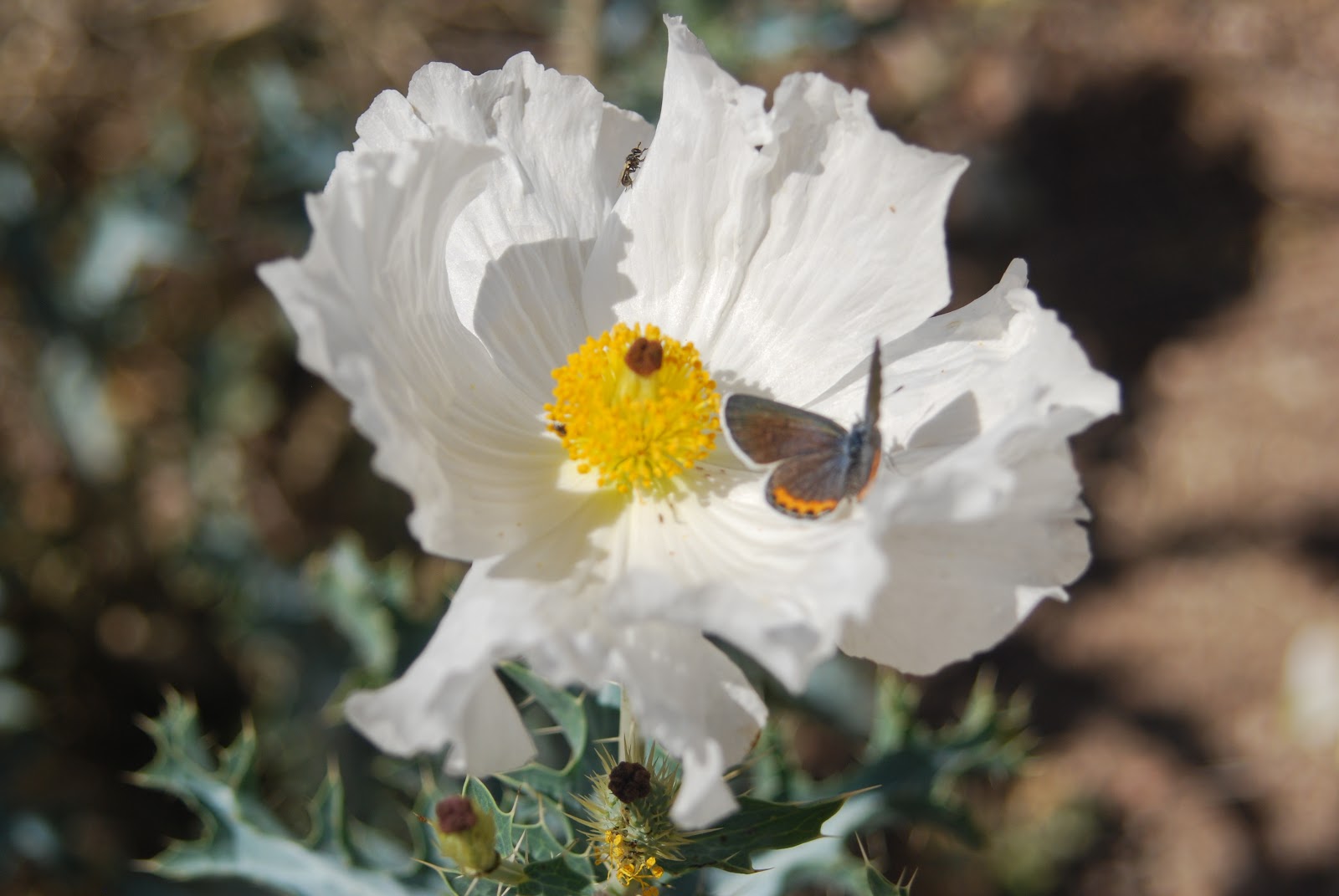
 It doesn't take much to sustain a butterfly, but it was a lucky photo opportunity.  

Nectar attracts these pollinators but the attraction is momentary until they travel to the next flower . . .maybe another prickly poppy.
But...maybe not.
  
Next for the butterfly was another plant with spines.  Unlike the prickly poppy, the prickly pear has a stem that has morphed into a spongy, water storing pad and "leaves" that have evolved to water conserving spines.  The pads carry a waxy coating that prevents water loss.  Shallow roots absorb the minimal desert rainfall, exaggerated reproductive characteristics (flowers) attract pollinators.  
The drive for life takes many forms.

Labels: , , , , , , , , , , ,

Monday, June 6, 2011

Nectar Is Sweet Stuff

We took a mini-trip over a local, seldom traveled gravel road in rural Az just for the helluvit. The road takes you into whatever still exists of undeveloped acres in rural Arizona. . . hills, scrub grassland, grease wood, brittle bush, and solitude. Just a dusty road and endless views.  
It's the type of environment that suggests you should change your auto air filter at the next opportunity.

These bees ain't Odysseus responding to the Sirens call and facing destruction.   In fact, there doesn't seem to be a risk to their activity.  They want nectar.
Bees of all kinds were having a play-day among the anthers and filaments of the flowers.


Going head-down for nectar, a bee actively stirs the anthers.  It's premature...the flower hasn't matured sufficiently for pollen to have been produced.  Usually you can see the grains spread around the petals.  But, the nectar is there and the bee wants it. 


Mellifera ligustica has a long proboscis (tongue) which extends to draw up nectar and water.

Belly down in stuff , a bee takes the hard way to its goal.

We often don't see the "little ones" that make life possible.  Our life is crowded with irrelevances.


After a long day of activity the cycle will begin again.  Probably tomorrow...flowers fertilized...bees happy...life continued...our auto air filter not replaced.  Life is perpetuated by small things.
  
However, the irony may escape our view.  Some bastard will use a fly swatter and an innocent perpetuator of life will bite the same dust that clogs my auto air filter.  

Labels: , , , , , , , , , , ,

Friday, May 13, 2011

Flowers of Boyce Thompson Arboretum

Honey Bee arrives for. . . dinner?  It doesn't realize but will certainly enter as a 2nd or 3rd party into an orgy of cactus fertilization.  Usually there are several that take part.
Open petals are sexy for bees and insects.  Bees have an easy time...among humans sex is selective, between flowers and bees, sex is indiscriminate.  .
Showered by fallen Paloverde blossoms this Hedgehog Cactus stands out.  It says, "Hey, look at me!!"  The Paloverde blossoms have had their chance.
Either a beaver tail cactus or what Boyce Thompson Arboretum calls a "red prickly pear cactus flower" it stands out like a stop light in the desert traffic.
One of the common yellow blossoms of the prickly pear.
The yellow/red is a common variation within the prickly pear family.  The prickly pear is notoriously "promiscuous", allowing pollen from a variety of related and unrelated species.
One of the Boyce Thompson "variants" from its "Cactus Garden."


Labels: , , , , , , ,

Monday, June 14, 2010

Cactus Flowers - A Carnival of Yellow

Nothing thoughtful or profound, just Prickly Pear blossoms taken at Boyce Thompson Arboretum a few miles from Superior, Arizona.


Labels: , , , , , ,

Saturday, May 22, 2010

Beauty and Destruction

We took a trip to the Boyce Thompson Arboretum (BTA) 3 miles outside Superior, Arizona.  Superior is one of those sad, deserted towns in Arizona that evolved from the boom/bust, truck economy of copper mining.  
The BTA, however, is a colorful jewel in the Spring when cacti bloom...the prickly pear, 
the buckhorn cholla,
the staghorn cholla
and all the color varieties that make these cacti a beautiful Spring surprise.  
Maybe the beauty of the BTA was focused a bit because of the waste of the strip mining in the surrounding region or, maybe, just because we had an innate desire for a spectacular afternoon...and wanted to escape a little of the destruction. 

Labels: , , , , , , ,

Thursday, September 17, 2009

Notoriously Promiscuous

A guidebook calls the Prickly Pear Cactus "notoriously promiscuous" because it often accepts pollen from species other than its own.   Flowers resulting from this promiscuity around Jerome, AZ, are colorfull and account for the yellow/red blossoms seen across Arizona in the Spring.

Note the insect at the lower left of the cactus flower...it's there feeding, watching, waiting for an encounter...just part of the diverse menagerie that keeps company with these soiled cactus doves of the desert. 

This environment doesn't take many chances, however...perhaps if the flower isn't fertilized notice the bud ready to open and start the process all over again.
Posted by Picasa

Labels: , , , , ,

Tuesday, September 8, 2009

Looking for Spring in All the Wrong Places

Occasionally it's satisfying to imagine Spring is here even before the Winter rains have come and gone. These Opuntia (Prickly Pear) cactus flowers were growing last April in Bumble Bee, Arizona, a cross-roads where mine waste fights for recognition with junk cars and discarded drug paraphernalia.
But even though a friend opined that I had been in the sun too long because of some ideas I had, you often can get around the problem (bad ideas) with a broad-brimmed hat and SPF 30+ sun screen.  Cactus flowers love the sun and we go into their world with the bees, spiders and other pollinators if we want their photos.

Sometimes one of the most useful tools we can take with us on these ventures is a monopod with an attached ball head that steadies our cameras on the rocky slopes that cacti always seem to choose for home.  Don't tell anyone, but us seniors carry these things as much to get around as anything else.

One of my favorites is the Dusky Prickly Pear (above) which some guide books call "notoriously promiscuous" for coming to the party with tinges of red...a sure sign it has allowed a wayward pollinator around its stamens and stigma...and accepted exotic pollen into its genetic arsenal. 
Posted by Picasa

Labels: , , , , ,