Wednesday, October 16, 2013

Managing Memories


For all my friends who wondered about the varied colors of globemallows, this
is the color/type seen commonly around the Northern part of Arizona.  

This butte is large.  For scale note the power-line tower in the lower right.  And I wondered later why I hadn't made an attempt to climb this thing. . . y'know, just for the view.

It was hot down at Organ Pipe Cactus National Monument even as leaves
on the Ocotillo indicate that it had rained within the last two weeks.  The flowers
were a bonus.

A skeletal bush filters the sunlight at Saguaro National Park.

 Tombstone Territory presents a more sylvan side than its gunfighter
reputation.

Pretty to look at, hellish to hike.   The first 300 yds., at least, were downhill . . . all the rest was just hot rock.


Labels: , , , , , , , , , ,

Saturday, February 18, 2012

Worse Than a Bee Sting

Jerome has a skunk problem.  The critters are as common as rats and if you have one there's a neighbor with a live-trap to help correct the problem.  But stories are unique in details of people who have trapped one then walked up to the trap and gotten sprayed...y'gotta have some perspective dealing with them.
I "possessed" a de-scented skunk years ago in an old college dorm. One night I let it out of it's cage for a 2 AM saunter through some of the halls and a drunk coming in after the bars closed stood in front of it as it cobbled an awkward walk along the baseboards.  The skunk (not the late-night drunk) sunk its canines through the top and bottom of the drunk's big toe (sandals y'know) and kept cobbling without a pause.  When the drunk had first spotted the thing he exclaimed, "What a cute Kitty."  It obviously took offense at being so grossly misidentified.
It's a long, long way in miles and years from that college dorm but you always have to be precise in identifying a threat.  If you go wrong ID'ing such a distinct black/white critter the result may be worse than a bite.  
While certain insects and reptiles are  recognized by remarkable colors...not your common raccoons and opossums...part of the perspective depends on you...beware of Jerome...or beware of something that lives there.    


Labels: , , , , , , ,

Thursday, September 29, 2011

Maybe She Will...Maybe She Won't

A big female crab spider about the size of a small quarter dollar.

Crab spiders or, more precisely, misusenoides formosipes, are found on flowers where they wait to ambush typical pollinators.
Popular thought says the spiders change color to match the flower they're on.  Fun!  This one was found  in a neighbors yard and the color match was so precise the camera had to define where the flower started and the spider ended.  
White crab spiders will sit in white Datura blossoms...yellow ones hide in...well...yellow blossoms.  
Two theories exist.  One is that when these spiders travel to a new location, a different flower of a different color, the spider's color will change in about a week.  The other theory postulates that they simply assume the color of the flower they were hatched on.
The result is probably academic...a female that changes color is fairly common.
Crab spiders make use of camouflage more than other spiders.  The color of the spider is adapted to the hunting terrain.
Because they sit in easily spotted places they become vulnerable prey.  When they spot a possible enemy they move quickly to the other side of their location or leave. 
Crab spiders are recognizable if you tease them. They spread their legs and move side ways...like a crab. 
Although crab spiders are fairly common, finding one might take some patience because they are often well camouflaged. If you want to find a crab/flower spider, try to think like a spider: Where would you sit if you wanted your prey to come to you?

Labels: , , , , , , ,

Friday, July 22, 2011

The Red Dragon

One hot day we drove several secondary roads in Arizona off Rt. 260 to Beasley Flat  which offered convenient access to the banks of the Verde River.  That day the access road was bumper to bumper cars of young people wanting to beat the heat.
Real heat seems to bring out insects of all kinds.  Dragonflies are a good example.
 
Genetically, dragonflies pre-date recorded history and modern classification is difficult because it is thought they are a combination of several very early species.  The difficulty is apparent in the Wikipedia description:  "an insect belonging to the order Odonata, the suborder Epiprocta or, in the strict sense, the infraorder Anisoptera."
They are usually found around lakes, streams and wetlands.  This day its winged morphology hung close to the Verde.
Dragonfly nymph under water displays vestigial wing cases.  
  As a nymph, the dragonfly is a fierce predator.  Its ultimate evolutionary form is indicated by the embryonic wing cases on the back of its thorax. When it morphs into the form familiar to most of us, it feeds on mosquitoes and other insects like flies, bees, ants and sometimes the occasional butterfly. 
Even though dragonflies have six legs they cannot walk well. 
 Dragonflies are some of the fastest insects in flight.  If one looks back far enough, however, it has passed through a much slower life. 

Labels: , , ,

Friday, June 10, 2011

It's a Prickly Life

When we drove a local gravel road the other day the visuals quickly changed from small town shops and restaurants to scrub desert, hills, ravines, endless views if you're up high . . . typical in rural Arizona.  

Wildlife was plentiful.  Hawks and golden eagles looked for mice and squirrels, and lotsa snakes that didn't like human companionship went about their business,  pushing these same mice and squirrels back into their burrows.

Flowers provided a carnival of color...prickly poppies, penstemons already tall, prickly pear in bloom.   

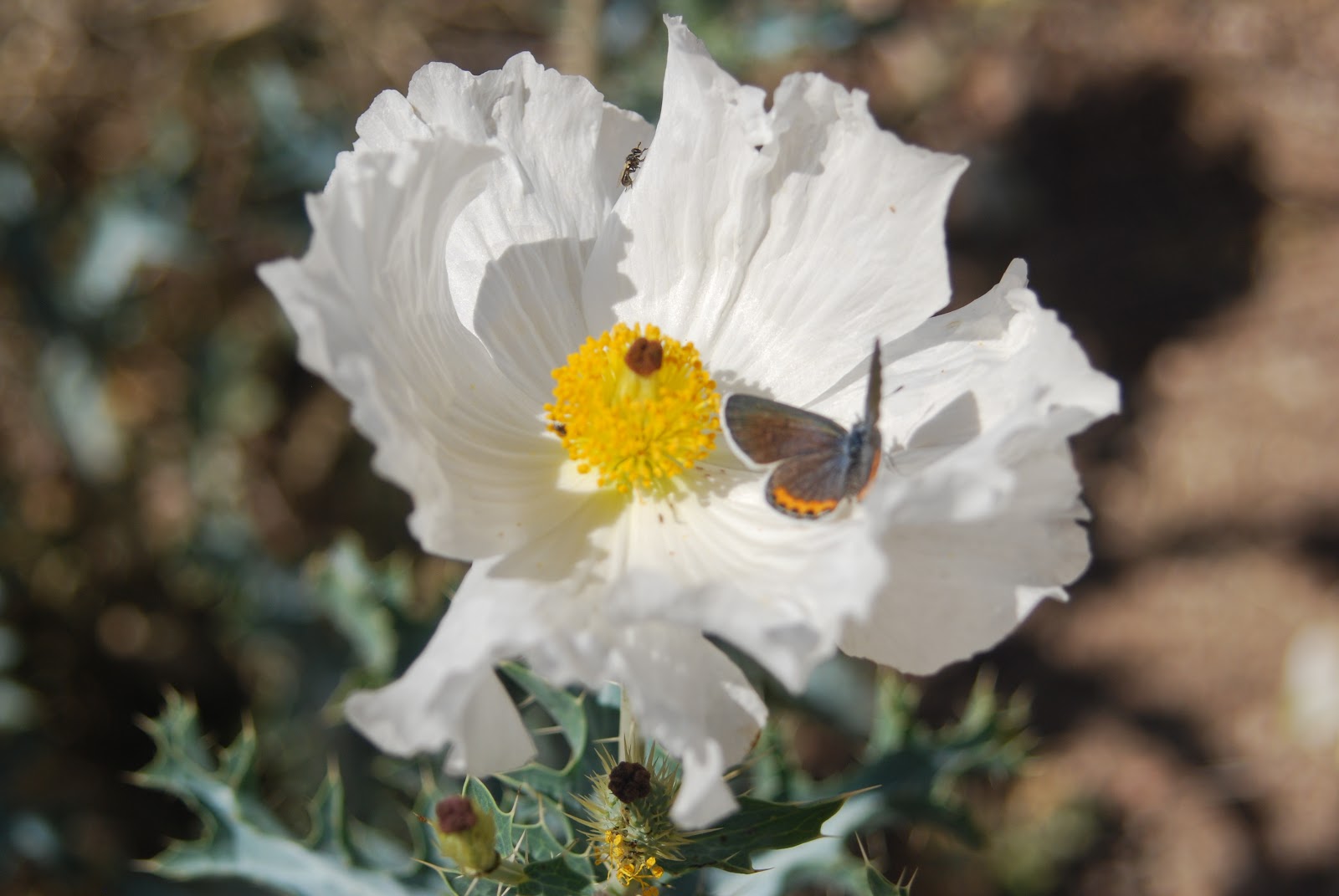
Prickly Poppies grow anywhere there's disturbed soil . . . roadsides, old garages, abandoned houses.  The attractive blossom belies the rest of  the plant. . . stems, leaves, and seed pods are covered with spines.
True to the poppy family the seeds provide a slight narcotic effect, if you're willing to endure working with the spine covered seed pod ( above,left....below, right/left).
Despite the wind that curled the petals a small butterfly negotiated its way to the flower, looking for nectar in all the meager places. 
 It doesn't take much to sustain a butterfly, but it was a lucky photo opportunity.  

Nectar attracts these pollinators but the attraction is momentary until they travel to the next flower . . .maybe another prickly poppy.
But...maybe not.
  
Next for the butterfly was another plant with spines.  Unlike the prickly poppy, the prickly pear has a stem that has morphed into a spongy, water storing pad and "leaves" that have evolved to water conserving spines.  The pads carry a waxy coating that prevents water loss.  Shallow roots absorb the minimal desert rainfall, exaggerated reproductive characteristics (flowers) attract pollinators.  
The drive for life takes many forms.

Labels: , , , , , , , , , , ,

Friday, May 13, 2011

Flowers of Boyce Thompson Arboretum

Honey Bee arrives for. . . dinner?  It doesn't realize but will certainly enter as a 2nd or 3rd party into an orgy of cactus fertilization.  Usually there are several that take part.
Open petals are sexy for bees and insects.  Bees have an easy time...among humans sex is selective, between flowers and bees, sex is indiscriminate.  .
Showered by fallen Paloverde blossoms this Hedgehog Cactus stands out.  It says, "Hey, look at me!!"  The Paloverde blossoms have had their chance.
Either a beaver tail cactus or what Boyce Thompson Arboretum calls a "red prickly pear cactus flower" it stands out like a stop light in the desert traffic.
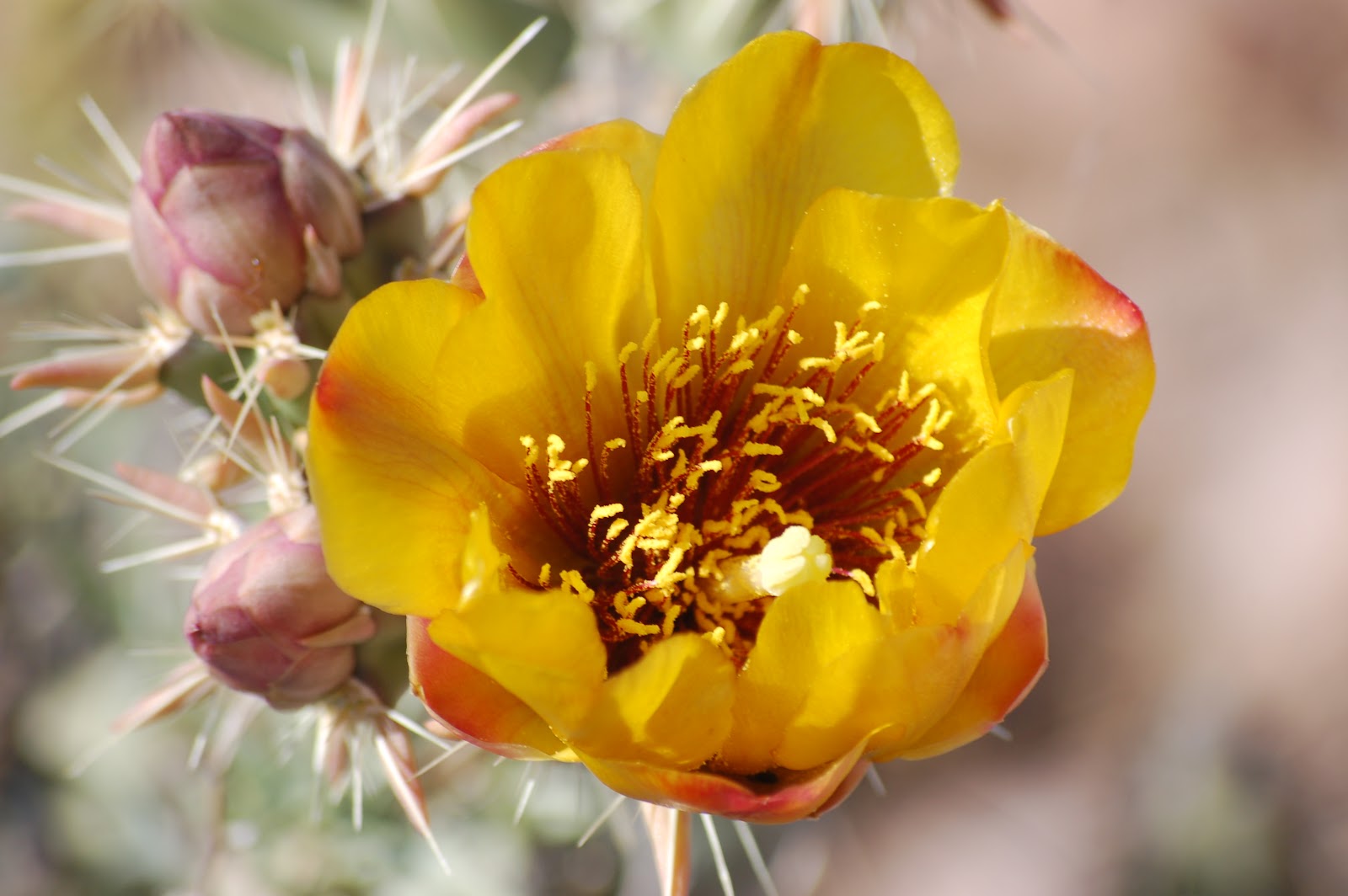
One of the common yellow blossoms of the prickly pear.
The yellow/red is a common variation within the prickly pear family.  The prickly pear is notoriously "promiscuous", allowing pollen from a variety of related and unrelated species.
One of the Boyce Thompson "variants" from its "Cactus Garden."


Labels: , , , , , , ,

Thursday, May 5, 2011

Wondering and Wandering in the Superstitions

If you're going to the Superstition Wilderness Area and not planning to camp, the only place to bed down at night is the nearby town of Apache Junction.  Thirty years ago this town was simply a crossroad of Arizona Rt. 88 and a road whose name I've forgotten.  Today, the town has a population of 37,000 and is a bedroom community of Phoenix.


Weaver's Needle is a landmark in the Superstition Wilderness.  Named
 for Pauline Weaver, a cavalry officer, it gained notoriety as being integral
to the supposed location of the Lost Dutchman's Gold.
  

The Apache Junction Motel was delightful because of its low rates and the nearby Mickey D's Cafe was delightful because of its oatmeal.  Low rates at the motel were balanced by outrageous prices at the gas pump.
The unique Teddy Bear Cholla blossoms belie the unique message the
spines convey: stay away unless you want a nightmare involving boots,
pants, socks, and even minutes later, car seats. 
Mickey D's Cafe had a sign proclaiming, "Because of the Current Drought, Water Will be Served Only on Request."   The nearby cacti would think that a good idea.


A bright Buckhorn Cholla can range in color  from red to orange to a
 brownish yellow...the spines have a serious purpose, also, but not quite
 as insidious.   
Our friend, the Western Diamondback, was never seen again.  I was happy it didn't want to be friends and I'm sure it was happy not to be in the company of Jeeps.


As most cacti and critters in the desert, a Western Diamondback rattlesnake
has "spines" of it's own.  It disagreed with our presence and struck at
the tire of our Jeep.  Except for  a missing fang or two all was OK.  The
fangs are replaced quickly. 
Despite the fangs and spines that are ubiquitous in the desert...it does have great sunsets.


All's well that ends well!


Labels: , , , , , ,

Wednesday, June 30, 2010

Lavender, White, and Red


Globemallows are common along the roadsides of Arizona...ranging in color from white to lavender, orange through red.  In the Spring and probably throughout most of the year these plants have sex. 
To get the full story you'll have to look to the bees and other crawlers whose primary purpose is to gather pollen.  It's only a secondary purpose to fertilize these flowers.
While the flowers leave reproduction to an industrious bee or thirsty hummingbird, it's none-the-less disconcerting that something as important as reproduction is abandoned to a secondary instinct.
 
We can contemplate this thought but get few productive results...
...or just look at the pics and realize that maybe flowers know something we don't.
This blog is dedicated to Olivia Judson whose column for the New York Times has, since I can remember, provided me with thoughts and insights, new ideas and perspectives.  She'll be taking a year-long sabbatical and will be missed.  Her bio should be common knowledge to anyone interested in the natural world.


Here's a snip:


Olivia Judson, an evolutionary biologist, writes every Wednesday about the influence of science and biology on modern life. She is the author of “Dr. Tatiana’s Sex Advice to All Creation: The Definitive Guide to the Evolutionary Biology of Sex.” Ms. Judson has been a reporter for The Economist and has written for a number of other publications, including Nature, The Financial Times, The Atlantic and Natural History. She is a research fellow in biology at Imperial College London.


Labels: , , , , ,

Tuesday, May 4, 2010

Spring Magic


It's kind of reassuring...they're always there...flowering on an annual basis.  Usually one of the first cacti to bloom, on a schedule of its own, Echinocereus engelmannii and some of its close cousins brighten the drab desert surroundings in the Spring. 
The bloom schedule has been variously attributed to temperature, the winter rains, sometimes to magic.
The contrast between this otherwise unremarkable cactus and the grasses that often surround it is brought to life when it flowers...kinda like waving a magenta flag while shouting, "Hey, look at me."
As they invariably do, bees and other insects will look and struggle through the stamens and anthers spreading pollen throughout the blossom and carry it to the next blossom, as well.
We all have a stake in this process...sometimes only to let us know that Summer is near...that there is something regular and timely in our lives.  A constant.

Labels: , , , , ,

Wednesday, April 28, 2010

Cactus Flower Road Trip

Recently we traveled south in Arizona looking for early bloomers.  We knew the Lupine and Penstemon, Mexican Gold Poppies and acres of Brittlebush would line the roads. We hoped to see Hedgehog Cacti, as well.   They never disappoint especially after a wet winter.


Perhaps I was just ready to see some old, familiar geography around Apache Junction and the nearby Superstiton Wilderness Area.  "Know where I can find a cheap motel," I asked the ancient guy at the Blue Bird Mine and Gift Shop.   Maybe I just wanted to get back to using my camera in the backcountry.  We were looking for cactus flowers but we'd take whatever we found.
What we found were numerous hedgehog cactus flowers (some of the first to emerge) but also a menagerie of wildflowers along the back roads.
Often you find globe mallow growing along roadsides....but the flowers are usually orange. This Spring, however, they came in a variety of colors ranging from white to violet to orange and a brick red.
We knew the globe mallows came in a variety of colors...but red?  The bees didn't seem to mind,  however, and pursued their pollinating with enthusiasm. 
All of which means little.  Even though Apache Junction has quadrupled in population and developed into a bedroom community of Phoenix, the flowers and bees are the same and keep company with the same Blue Bird Mine and Gift Shop.

Labels: , , , ,

Thursday, February 4, 2010

Sky Fire

Luminance, water drops, and rocks. . .each a vision.  


Labels: , , , , , , ,